There are both good things and challenging things about living out in the country. It’s nice to be able to see the stars at night; it’s about five degrees cooler out here than it is in the city since there is less pavement and more trees (very helpful on a day like today!); and it’s usually pretty peaceful and quiet. Some of the downsides are that no one will deliver take out to you; if you need butter or sugar, the nearest grocery store is fifteen minutes away; and most frustrating for me lately… our internet connection can be pretty awful. We still don’t have fiber optics out here and may not for another two or three years. (Yes! I said years!) This past week have been especially challenging as the internet has gone in and out at unpredictable times and has stayed out for hours and hours. I hope that all of this comes through okay!
What’s in My Box this Week?
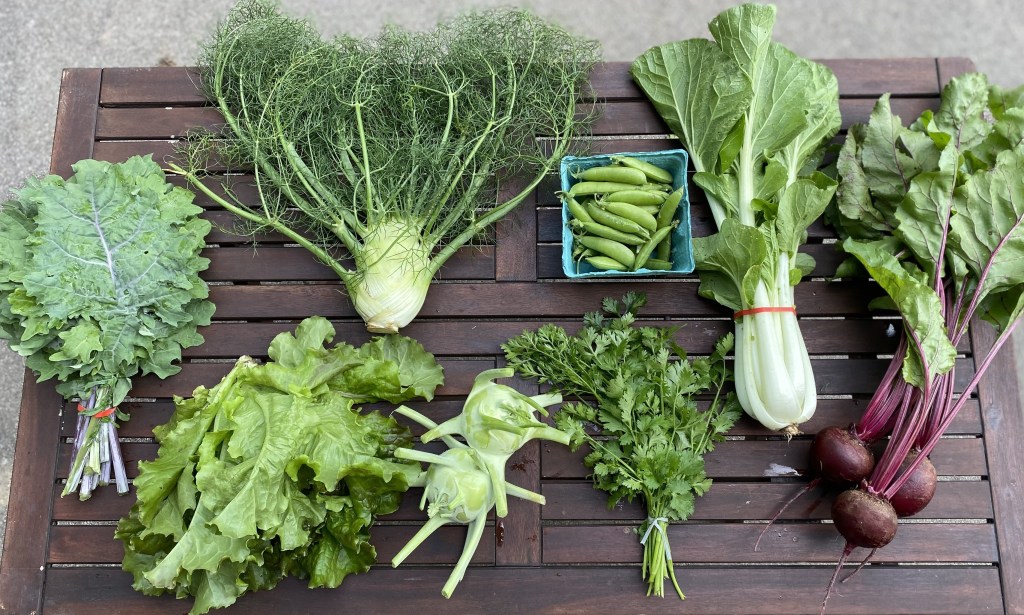
BOK CHOY – Store unwashed in the crisper drawer of your fridge. Use within a couple days for best texture. Greens will wilt relatively quickly. Stems will retain firmness a while longer.
BEETS – You can use both the roots and the leaves of beets. If your beets still have greens attached, cut them off, leaving an inch of stem. Store the beet roots unwashed in a plastic bag in the crisper bin of your refrigerator. They will keep for several weeks. For the greens, keep them dry and unwashed until ready to use in a sealed plastic bag in the fridge for up to a week.
CILANTRO – I thought I might give you garlic chives this week, but when I was in the field earlier today I saw that the next planting of cilantro is ready to harvest and I don’t want it to bolt, so you’ll get some more of this tasty herb this week. Stand upright in a container with an inch of water. Then cover the herbs loosely with a plastic bag and refrigerate for up to 2 weeks.
FENNEL – This is another new crop for me and I’ve only eaten it a couple of times, so we will be learning about this veggie together. Fennel is used in a lot of Italian cooking. The bulb is mild and can be used as an onion, but it also has a subtle anise flavor and anise is used in lots of common Italian foods like Italian sausage and pizza. We use anise seed when seasoning our homemade pizza sauce, and it adds a lot of flavor.

Unfortunately, the germination rate for the fennel seeds I started inside this spring was exactly zero. Fortunately, Easy Yoke Farm has some fennel they can sell me, so I am going to buy the bulbs in from them. I’m also going to experiment with starting some seeds out in the field this week, so maybe you will get some more fennel later in the season, if it works.
If you plan to use the fronds (delicate leaves), remove these before storage. Place the bulbs in a plastic bag in the fridge for up to two weeks. Wrap the leaves in a moist paper towel and store in the fridge for up to a week. Here is a tutorial from Lauren at Raleigh’s Hilltop Farm about how to cut it up.
KALE (Red Russian) – Keep in the crisper drawer of your fridge or loosely in a plastic bag to seal in the moisture. Use within a week.
KOHLRABI – A member of the brassica family (veggies like cabbage, broccoli, cauliflower, Brussels sprouts, and kale are all in this family), kohlrabi means “cabbage turnip” in German and that is pretty much spot on: it looks like a turnip once its skin is removed and tastes a lot like a cabbage. You can eat kohlrabi a bunch of different ways. You can just cut it into sticks and eat it raw with some veggie dip for a quick snack or use it raw salads. You can also do a quick pickling for a taco or grain bowl topping, and you can cook with it as well. Here is a tutorial showing three different ways to cut up a kohlrabi, depending on how you use it.
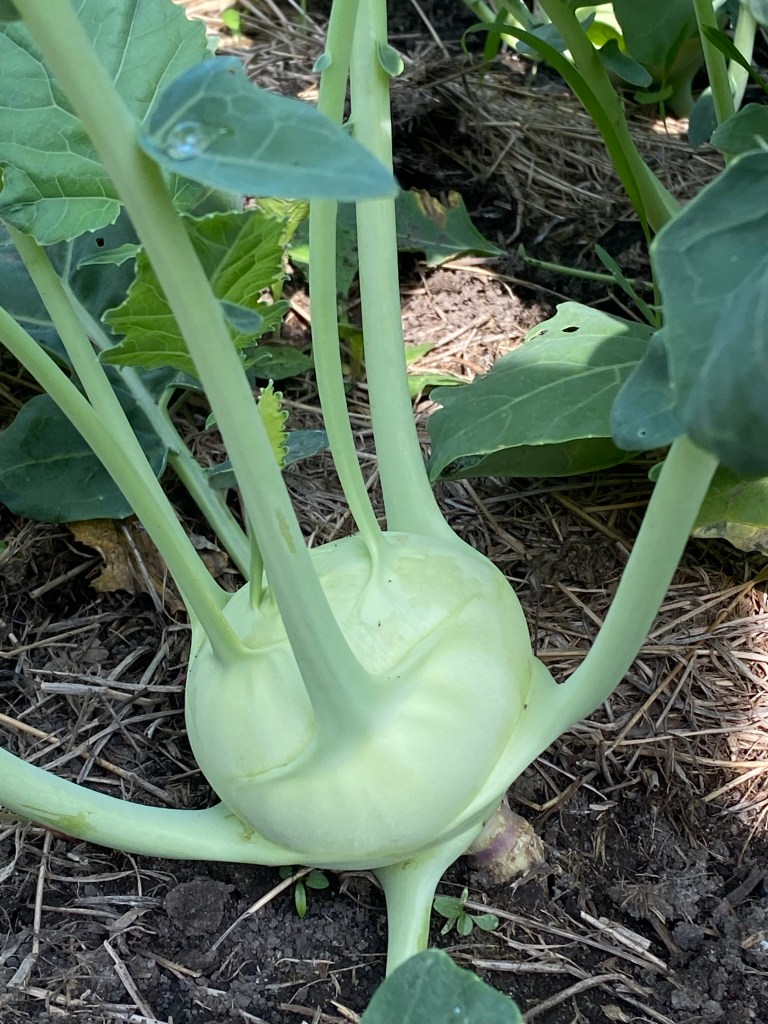
Store kohlrabi globe and leaves separately. The bulb will last for two weeks refrigerated in a plastic bag. Wrap leaves and stalks in a plastic bag and keep in the crisper drawer of the refrigerator.
LETTUCE – Store loosely in a plastic bag in the crisper drawer of your fridge. Keep unused leaves on the head. Ideally use within a week, but it will probably store for up to two weeks if needed.
SUGAR SNAP PEAS – As with last week, this week your peas will be coming from Easy Yoke Farm again. Peas are very perishable, and snap peas are best eaten fresh. Keep them in the fridge and eat within two to three days.
Notes from the Field
Things are plugging right along on the farm. We are well on our way to having lots of different veggies ready to share soon: the cabbages and broccoli are forming heads; the zucchini and summer squash are fruiting (little tiny ones right now, but they’ll be ready next week); the green beans are flowering; there are small tomatoes on almost every tomato plant; and the ground cherries and tomatillos are setting and ripening their fruits. You have a lot to look forward to!
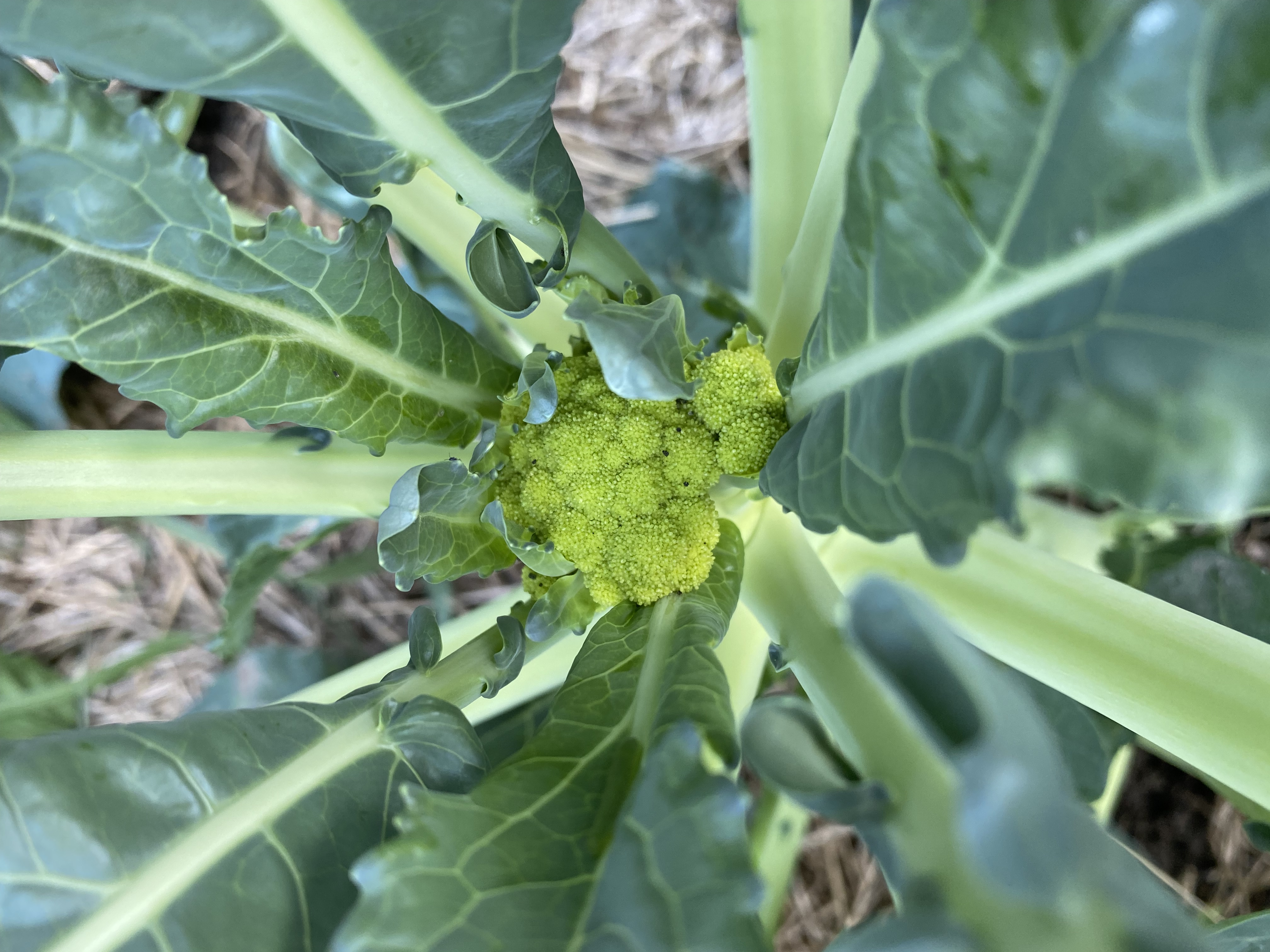
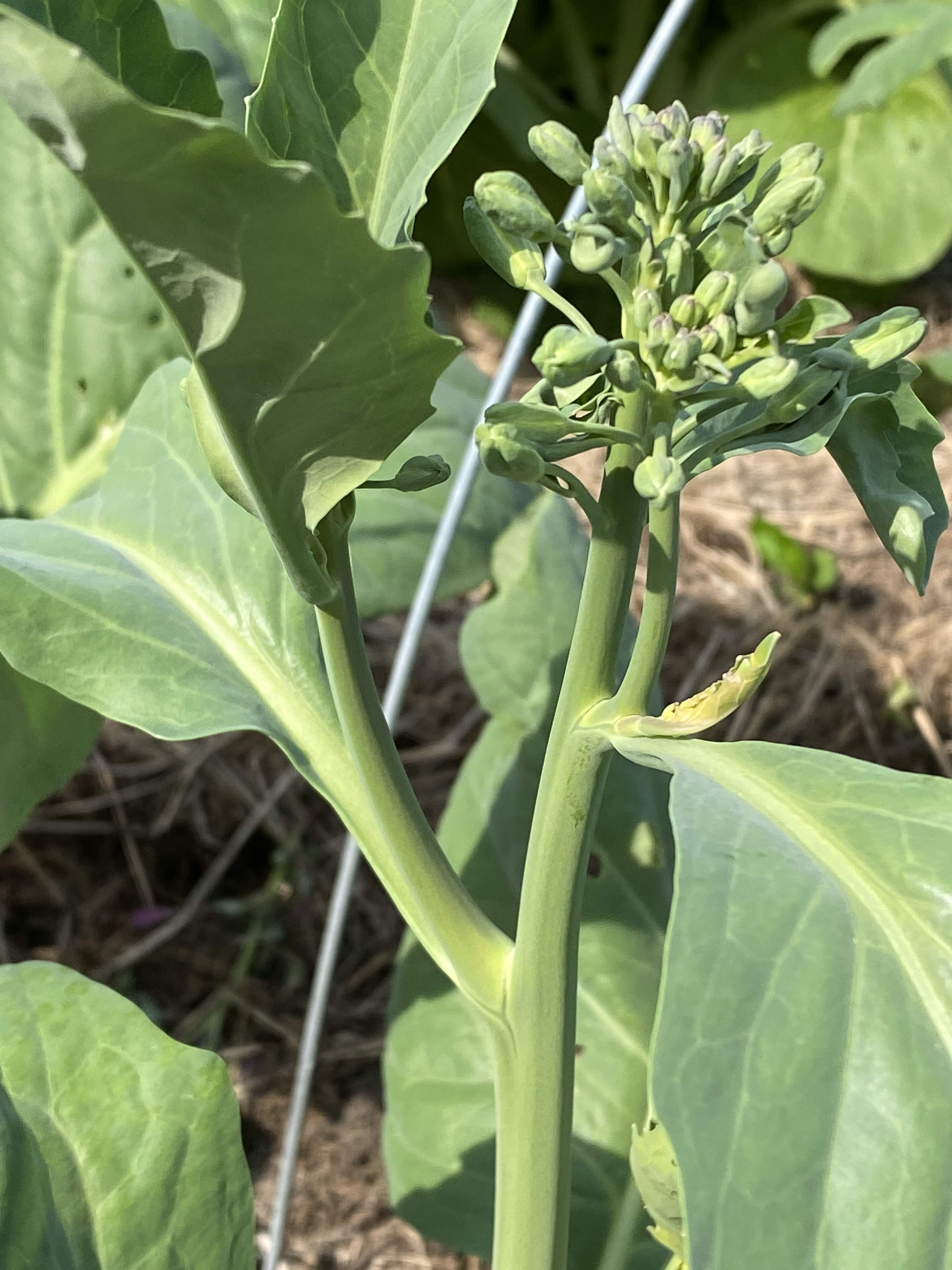
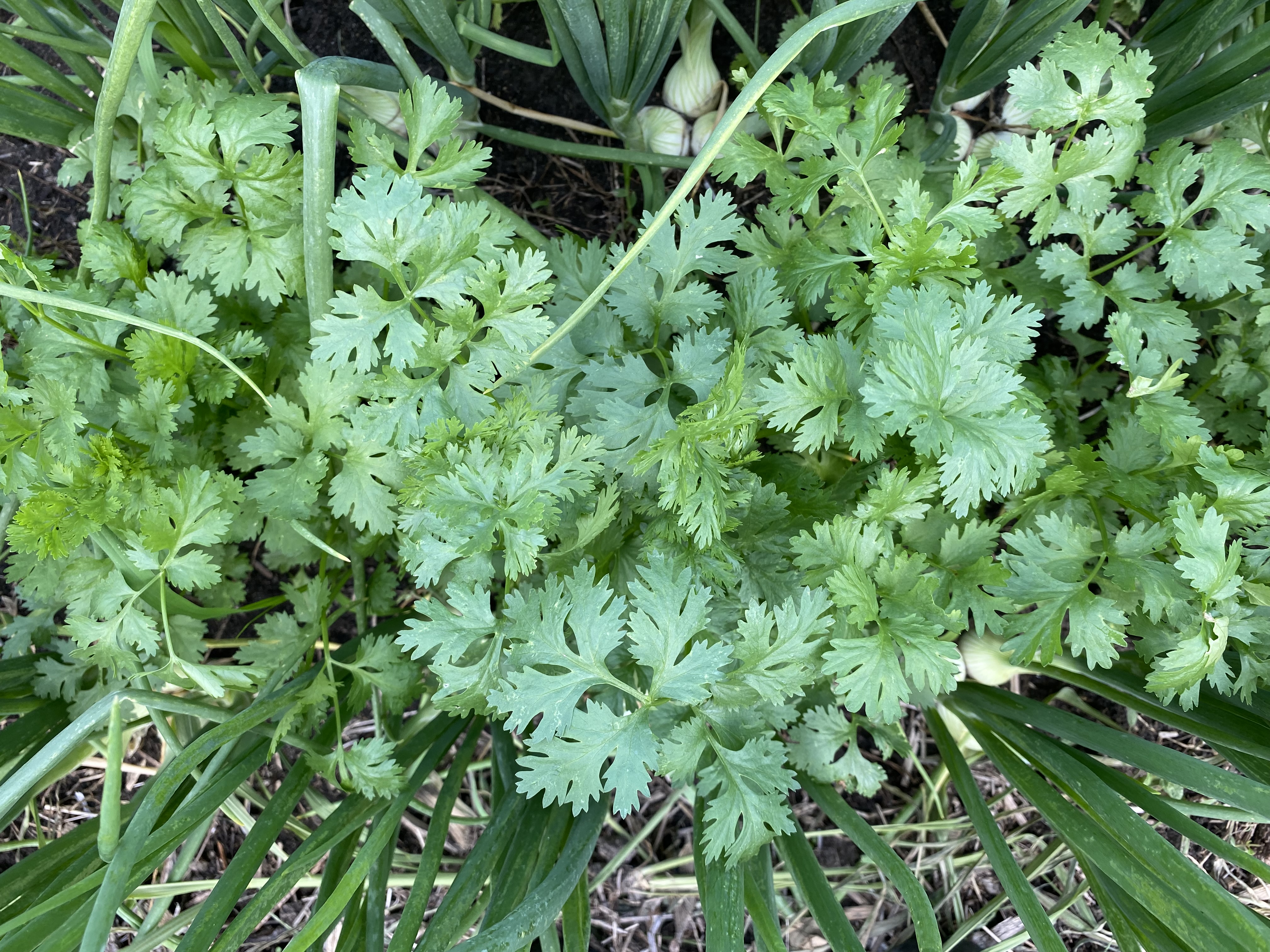
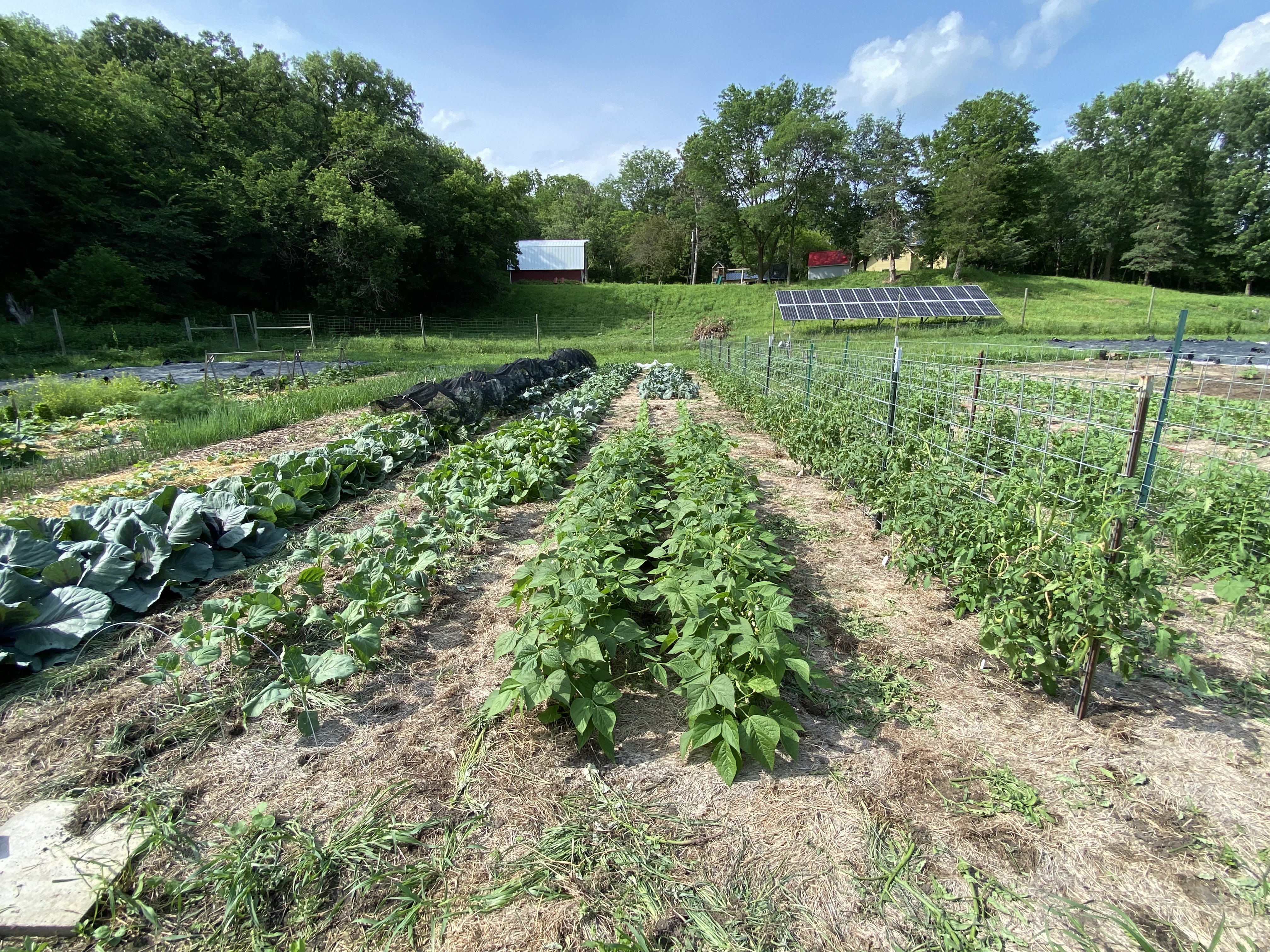
This past week I weeded some more, tied up the tomatoes some more, and spread some straw underneath the cucumbers and melons to try and keep them dry and off the bare soil. (This helps to prevent some soil-borne diseases that like to infect these crops in the warm, wet weather we’ve been having.) I’m also seeding some fall crops like Romanesco cauliflower, watermelon radishes, broccoli, and cabbages.
One of our biggest tasks was to weed the garlic again. This time was rather more exciting than last time though. As Simon and I were sitting on the ground weeding across from each other, I heard a strange sound just behind me. Imagine my shock when I turned around to find three baby skunks playing together just two feet away from me. I didn’t know I could jump up that quickly! Simon and I tore off running out of the field and then watched from a safe distance as three more babie came out to frolic. Their mother must have heard them because all of a sudden, she came tearing through the potato patch right at us before deciding to reverse course and leave us alone. (Phew!) We kept watching the babies until they sauntered off, nervous about being sprayed but also grateful to have witnessed this. Baby skunks are adorable, and this was probably the first and last time we’ll ever see them in the wild. There is never a dull moment on the farm, that’s for sure!
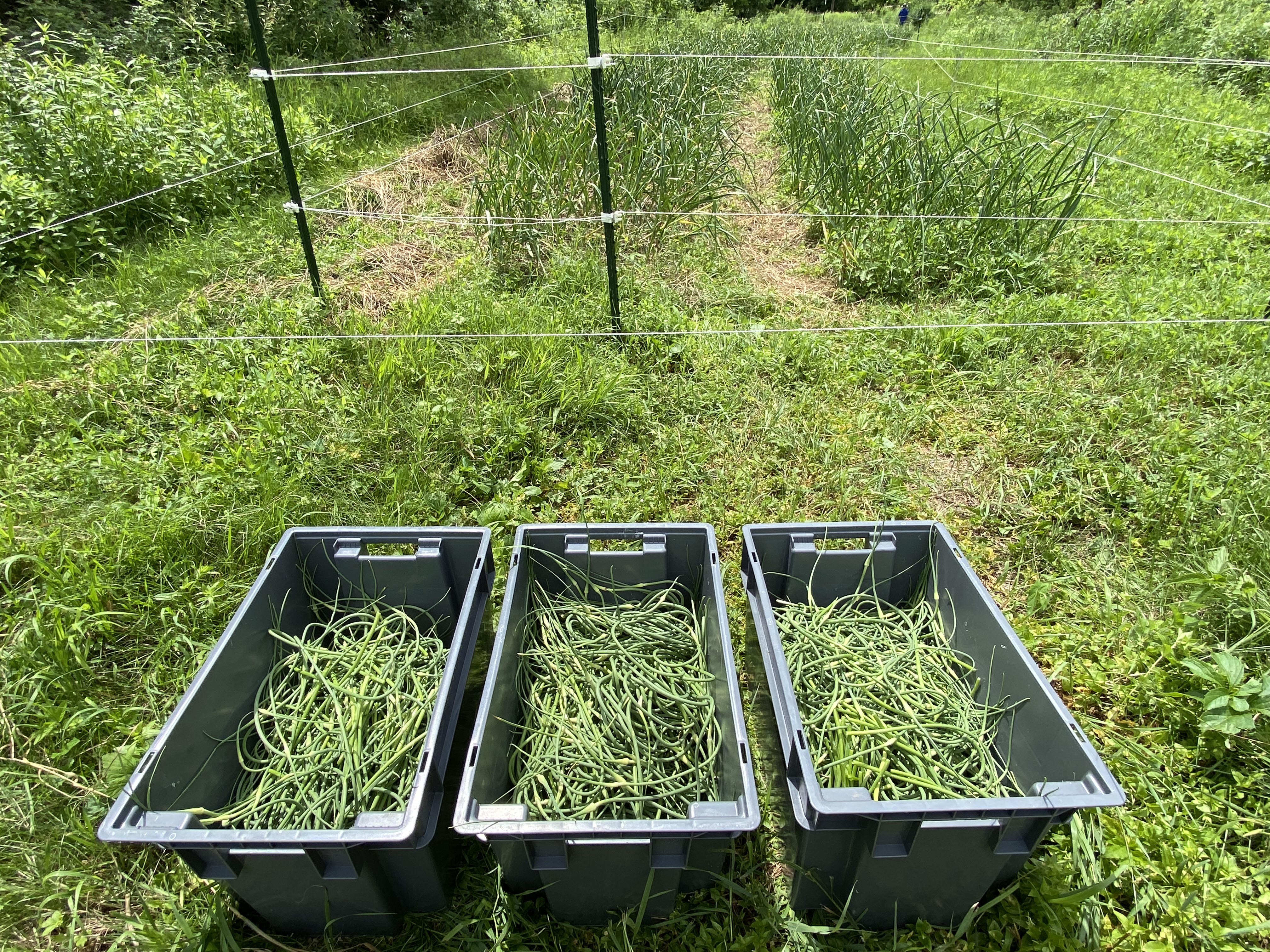

The other garlic-related work we did was to harvest all of the garlic scapes. The varieties of garlic that we grow are hardneck (as distinguished from softneck varieties). Hardneck varieties tend to grow best in colder, northern climates, and we’ve had good success with them. They send up a flower stalk called a “scape” that starts at the base of the garlic bulb and goes up through the neck. This stalk causes the neck of the bulb (the place where the stalk meets the bulb) to have a “hard neck” and thus, the name. If you fail to cut these scapes off at a certain time, the garlic plants put all of their energy into flowering rather than growing big bulbs, so Simon came out and helped me make short work of it. Would you believe it only took the two of us one hour to harvest around 3,000 scapes? Of course, our hands smelled of garlic for what seemed like days afterwards, but I love that smell, so it was alright with me!
Recipes
Make sure to scroll down to last week’s newsletter where I put a bunch of recipes for beets, cilantro, bok choy, etc. that you have in your box again this week.
Beet, Sugar Snap Pea, and Avocado Salad // Uses Beets, Snap Peas // Vegetarian
Burrata with Charred and Raw Sugar Snap Peas // Uses Snap Peas // Vegetarian
Kale Salad with Apples and Cheddar // Uses Kale // Vegetarian
This is one of our favorite ways to use kale. The recipe comes from Martha Rose Shulman and was featured in Salads with Sweetness, Crunch, and Zest
Makes 4 to 6 servings and takes 5 minutes to prepare.
- 4 cups very finely chopped or slivered curly kale or Russian kale (about 6 ounces on the stem, or half of a 3/4-pound bunch, stemmed and washed in two rinses of water)
- 2 tablespoons coarsely chopped toasted almonds
- 1 apple, sweet, like a Fuji, or a sweet-tart, like a Gala, Braeburn or Pink Lady, cored and cut in 1/4-inch dice
- 1 ounce sharp Cheddar cheese, cut in 1/4-inch dice
- 2 tablespoons fresh lemon juice
- Salt to taste
- 1 very small garlic clove, puréed
- 5 tablespoons extra virgin olive oil
- 2 tablespoons freshly grated Parmesan
- Combine the kale, almonds, apple and Cheddar in a large bowl.
- Whisk together the lemon juice, salt, garlic and olive oil. Add to the salad, and toss well. Sprinkle the Parmesan over the top, and serve.
Kohlrabi and Kale Salad // Uses Kohlrabi, Kale // Vegetarian
This is best made ahead and allowed to sit in the fridge for a few hours before eating. Also, make sure to “massage” your chopped up kale (rub it around between your hands) with olive oil before adding it to the salad.
Kohlrabi and Carrot Slaw // Uses Kolhrabi // Vegetarian
Lily’s Lemony Fennel, Radish, and Kale Salad // Uses Fennel, Kale (you can substitute the kale in your box for dinosaur kale), Radishes (if you have some left over from last week, but you don’t need them for this recipe to work) Sugar Snap Peas // Vegetarian
Roasted Chicken with Clementines and Arak // Uses Fennel
Sausage, Greens, and Beans Pasta // Uses Kale (or Rainbow Chard if you have some left over from last week)
Sesame Noodles with Kale and Mushrooms // Uses Kale, Garlic Scapes (if you have some leftover from last week)
Sesame sauce adapted from Molly Yeh; Recipe from The Leek & the Carrot
Makes 2-4 servings
Takes 20 minutes
2 tablespoons peanut oil
1/2 pound baby bella or crimini mushrooms, sliced
1 bunch kale, stems removed, chopped
Kosher salt and freshly ground black pepper to taste
8 ounces of your favorite Asian noodle (I used Udon but would have used Soba if I had any)
Sesame Sauce:
3 garlic cloves, minced
3 tablespoons soy sauce
3 tablespoons honey
3 tablespoons tahini
2 teaspoons sesame oil
1 (or 7) pinches of red pepper flakes
- Heat peanut oil in very large skillet (or wok if you have one) over medium high heat.
- Add mushrooms, stirring often, for 5 minutes until tender. Add kale and continue cooking (and stirring) until wilted. Salt and pepper to taste.
- Bring a large pot of salted water to a boil. When boiling, add noodles and cook according to packaged directions. Drain and rinse with cold water.
- Meanwhile, prepare the sauce by combining all sauce ingredients in a mason jar and shaking vigorously (you could also mix it in a bowl but I like this method because then you can make a double, triple, whatever batch and easily save the leftovers without dirtying a dish).
- Combine kale, mushrooms, cooked noodles and sesame sauce in a large bowl. Eat warm or cold.
Shaved Apple and Fennel Salad // Uses Fennel // Vegetarian
Takes 15 minutes
Serves 2-4
1 Granny Smith apple
1 large fennel bulb
Apple maple vinaigrette (below)
Pinch red pepper flakes
1/2 cup halved walnuts, toasted
- Cut unpeeled apple into 1/8-inch thick slices (with a mandoline or fancy knife skills). I sliced one side until I reached the core and then continued on another side and continued all the way around the apple until only core remained. This yielded slightly different size pieces, but it didn’t seem to matter much.
- Cut the stems and base off your fennel so that you are only left with the bulb. Cut it in half lengthwise and remove the core (it will be in the middle and kind of triangular; it will be much harder than the rest of the fennel and pretty obviously inedible). Cut each half into 1/8-inch thick slices (again mandoline is preferred but fancy knife skills will work too).
- Throw apple and fennel into a medium bowl. Toss with half of the vinaigrette and red pepper flakes. Taste and add more vinaigrette according to your preference. Add toasted walnuts and serve at room temperature or cold.
Apple Maple Vinaigrette
2 tablespoons olive oil
2 apple cider vinegar
2 tablespoons maple syrup
1/2 tablespoon lemon juice
1/2 teaspoon stone-ground mustard
1/2 teaspoon Kosher salt
Few grinds of black pepper
- Combine all ingredients in a small bowl. Whisk vigorously until well-combined and slightly opaque in color (this means it’s emulsified!).
- Taste and adjust seasonings to your preference. Don’t forget that the apple will add quite a bit of tartness and sweetness to the overall salad.
Steak Sandwiches with Fennel Slaw // Uses Fennel, Cilantro
 Middle Fork Farm