
Friends, I am grateful that today is newsletter writing day. I was just out in the field for a couple of hours this morning and thank goodness I wrapped up all my field work before the temperatures really started soaring. Erik likes to remind me that I used to adore hot, sunny, ninety-degree days back when we were first married. Of course, this was when I worked inside at a computer most of the time and so those sorts of days were a nice change of pace. Now, I am thrilled when we have a cloudy day, and my preferred temperature is probably between sixty and seventy degrees. How things change!
What’s in My Box this Week?
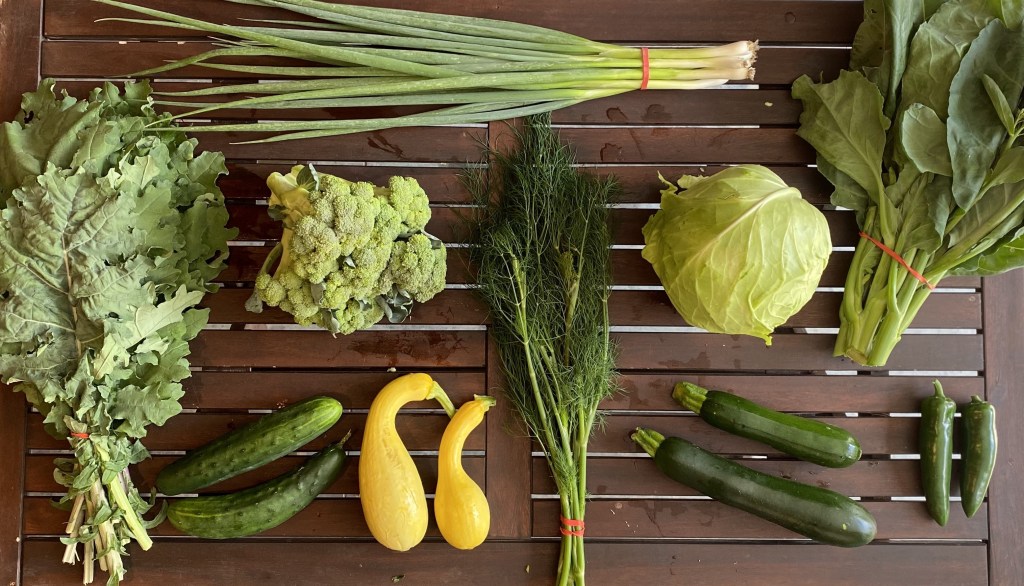
Broccoli – Wrap broccoli loosely in a plastic bag and keep it in the crisper drawer of your refrigerator. The colder, the better. Store for a week.
Cucumbers (Large Shares Only) – if you don’t get these this week, you will next) – Place cucumbers in a sealed plastic bag in the crisper drawer of the refrigerator for up to a week.
Dill – For short-term storage, stand upright in a container with an inch of water. If you won’t use it within a couple of days, place the dill in a plastic bag and place in the fridge for up to two weeks.
Green Cabbage – Cabbage can store for three weeks to two months and it doesn’t require much special care to have it last this long. Just keep it in the crisper of your fridge and remove the two outer leaves before eating. (These leaves are used to help store the cabbage.)
Jalapeno Peppers – If you don’t get these this week, you will next.) – Refrigerate peppers unwashed in a sealed plastic bag in the crisper drawer for one to two weeks. You can also dehydrate peppers for long-term.
Kailaan/Chinese Broccoli (Large Shares Only) – Store in a closed plastic bag in the fridge for up to a week.
Red Russian Kale – Place kale unwashed, wrapped in a sealed plastic bag in the crisper drawer of the refrigerator. Best used very fresh, but may last for a week.
Scallions – Store in the veggie drawer of your refrigerator and try to use within a week. If you use these after a week, you can peel off any dry and/or “slimy” outer layers of the onion.
Yellow Crookneck Squash – Store them in the crisper drawer of your fridge, but try to use within a week as they will quickly get soggy. You can use these interchangeably with zucchini in recipes.
Zucchini – Same storage and instructions as for Yellow Crookneck Squash above.
Notes from the Field
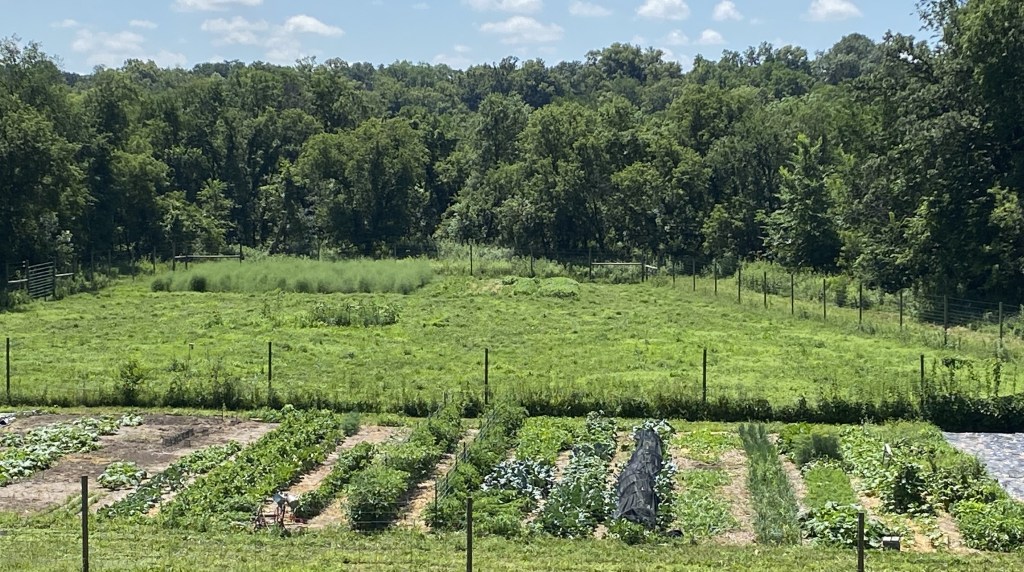
This past week was spent primarily getting things in tip top shape for the field day that we hosted here this past weekend. Erik spent a day pulling weeds from our edible hedgerow (and fixing the fence that those darned deer had once again broken through); I pulled invasive wild parsnip and plumeless thistle from all over the place; we mowed some walking paths; and the kids finished weeding the vegetable field. I have to say that the homestead hasn’t looked this good in a long time. So many flowers are now in bloom, and this week we are looking forward to reaping the rewards of all our hard work. Besides harvesting, there is hardly any field work to be done and we have several days of summer fun ahead!



The field day was a good success. We had lots of questions from folks – so many, in fact, that the program ran over by an hour. Karin Jokela from Xerces Society and Jorgen Rose from Practical Farmers of Iowa helped by sharing their expertise with the group (thank you!), and Erik and I enjoyed showing people around and hearing people’s reactions to the work we’ve done so far. I hadn’t been out to the prairie and savanna for several weeks, and it was great to see new native plants that hadn’t been there before popping up. I think this means that all our efforts at clearing invasives is starting to pay off. I hope that everyone who came will go home and plant pollinator habitat wherever they can!

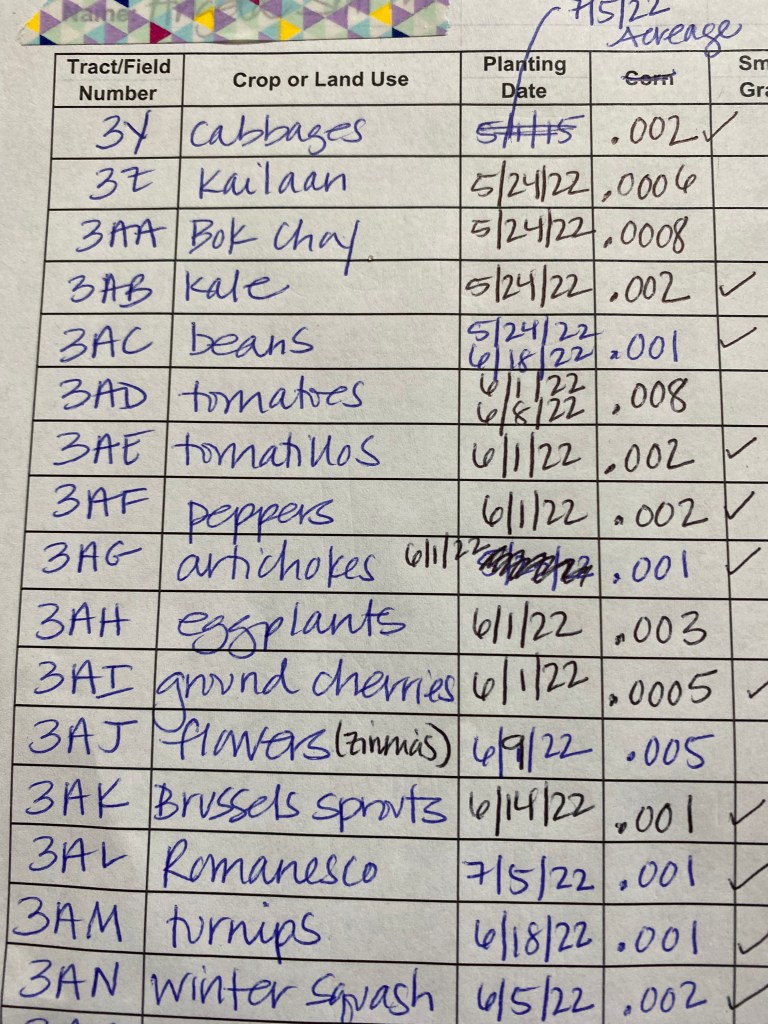
Other than that, I had to do some paperwork for the USDA. Every year, farms like ours that participate in USDA programs are required to report how many acres of each crop they plant by July 15th. The reporting system is really geared toward large-scale row crop farmers and so I often find myself amused when I’m crunching the numbers for the report. This is because you are required to report how many acres you’ve planted of each crop. In my case, I must convert square footage into acres and the acreage size of each of my crops is always super small. (My biggest field is 0.11 acres of asparagus!)
Here is a photo of the spreadsheet so you can see what I’m talking about.
The staff at USDA are always good sports about this, but I am sure their jobs are much easier when someone comes in and lists that they planted 1,000 acres of corn, end of report. Anyhow, when you add up all the space that I’m using to grow for the CSA alone, it comes out to around only one-third of an acre. It’s amazing how much food you can grow in such a small space!
Recipes
Cabbage, Bacon, and Egg Noodles // Uses Green Cabbage
From Women’s Day cookbook (I usually double this recipe)
4 ounces medium-wide egg noodles
2 slices bacon, diced
1 tablespoon butter
1 tablespoon olive oil
1 medium-sized onion, sliced thin
1/2 teaspoon minced garlic
1/4 cup chicken or veggie broth
1/4 dry white wine or additional chicken/veggie broth
1/4 teaspoon salt
1/4 teaspoon ground black pepper
1 1/2 pounds (9 cups) shredded green cabbage
1 teaspoon poppy seeds
- Bring a large pot of water to a boil. Add the noodles and cook according to the package instructions. Drain well.
- Meanwhile, in a large skillet, cook the bacon over medium heat until crisp. Remove with a slotted spoon to paper towels. Wipe the skillet clean.
- In the same skillet, melt the butter over medium heat. Add the onion and cook, stirring often, for 6 to 7 minutes, or until the onion is softened. Add the garlic and cook, stirring often, for 1 minute.
- Add the broth, wine, salt, and pepper. Bring to a boil and boil for 1 minute.
- Add the cabbage. Stir over medium-heat for 3 to 5 minutes, or until crisp-tender.
- Stir in the bacon, then the noodles and poppy seeds. Cook just until the noodles are heated through. Serve right away.
Chickpea Salad with Carrots and Dill // Uses Dill // Vegetarian
Cousin Deb’s Cucumber Feta Dip // Uses Cucumbers, Dill // Vegetarian
1 cup (4 oz.) feta cheese, crumbled
2 tablespoons fresh lemon juice
¼ teaspoon freshly ground pepper
1 ½ cup cubed, seeded, peeled cucumber
1 cup finely chopped red onion
3 tablespoons chopped fresh mint
3 tablespoons chopped fresh dill
- Combine feta, lemon juice, and pepper. Partially mash with a fork. Add cucumber, onion, mint, and dill. Serve with pita chips.
Dill Flavored Butter // Uses Dill // Vegetarian
From Simply in Season cookbook
1/2 cup softened butter
1 shallot or 1/4 cup chives
1 clove minced garlic
2 tablespoons minced dill (or basil or parsley)
1 teaspoon lemon or lime juice (optional)
- Mix and form into a ball or fill a small bowl.
Herbed Summer Squash Pasta Bake // Uses Summer Squash or Sub Zucchini, Throw in a Jalapeno for some spice // Vegetarian
One-Pot African Peanut Stew // Uses Jalapenos, Sub Kale for Collards // Vegetarian
Quick Pickled Jalapeno Peppers // Uses Jalapenos // Vegetarian
Perfect Roasted Cabbage // Uses Green Cabbage // Vegetarian
Roast Salmon and Broccoli with Chile-Caper Vinaigrette // Uses Broccoli, Jalapenos
Sheet Pan Chicken Fajitas // Uses Jalapenos
From Raleigh’s Hillside Farm
1 – 1.5 pound(s) boneless skinless chicken breast, cut into thin strips
1 onion, cut into thin half rings
2 or 3 yellow peppers, cut into thin strips
1 or 2 jalapeno peppers, diced small or cut into very thin half strips
Seasoning mix:
2 tablespoon vegetable or canola oil
2 teaspoon chili powder
2 teaspoon ground cumin
½ teaspoon salt
½ teaspoon freshly ground black pepper
For serving: tortillas, sour cream, tomato wedges, minced cilantro, salsa, avocado
- In a large bowl, mix together all seasoning mix ingredients, including oil. Feel free to add more if you prefer. Add all the strips of chicken, onion, peppers and jalapenos to the bowl and toss with tongs until everything is well coated. Spread out on a baking sheet sprayed with cooking spray.
- Bake, uncovered, at 400⁰ for 20-25 minutes or until chicken is no longer pink and veggies are crisp tender. Spoon into warmed tortillas and add desired toppings.
Thai Mango Cabbage Wraps with Crispy Tofu and Peanut Sauce // Uses Green Onions (Scallions), Green Cabbage
 Middle Fork Farm